Howard D. Routman, DO

Conditions

Shoulder replacement

When the joint has worn out, the surfaces can be replaced. There is more than one kind of replacement, and which one is right for you turns largely on the state of your rotator cuff.

When a shoulder gets replaced

Cartilage is the smooth surface that lets the ball turn in the socket. When it wears away, bone rubs on bone. The shoulder aches, grinds, stiffens, and stops doing what you ask of it. For a lot of people the thing that finally brings them in is not the daytime pain — it is not being able to sleep.

Replacement is not the first thing tried. Therapy, changing what you ask the arm to do, anti-inflammatory medication and injections come first, and many people never need more than that. Replacement is for a joint that has gone past what those can help.

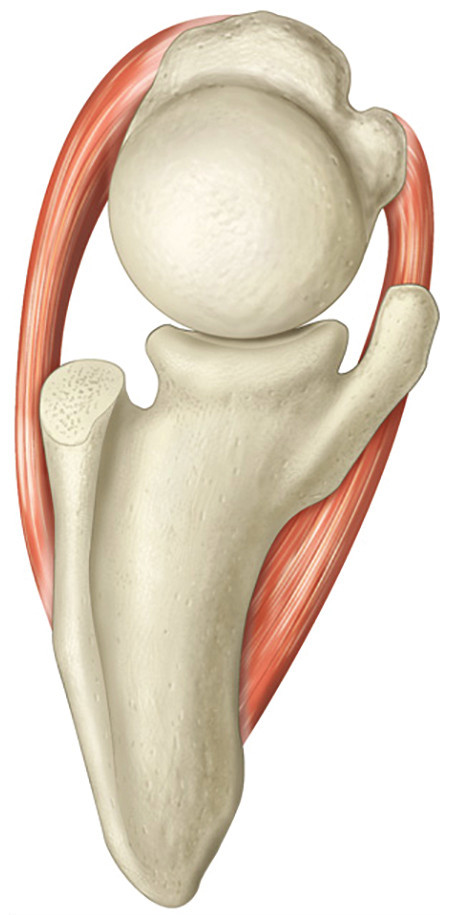
An axial view of a shoulder, looking down through the joint from above. The ball sits in the socket with the front and back of the rotator cuff intact and no arthritis.

A normal shoulder, from above

From a peer-reviewed publication on which Dr. Routman is a listed author.

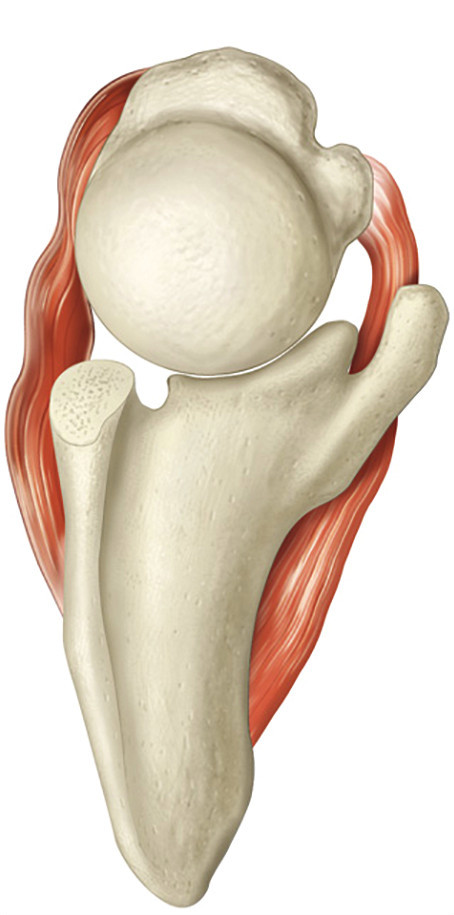
The same axial view of a shoulder in which the back of the socket has eroded, so the ball has shifted backward into the worn area.

The back of the socket eroded

From a peer-reviewed publication on which Dr. Routman is a listed author.

Both are axial views — looking down through the shoulder from above. In the first the front and back of the rotator cuff are intact and there is no arthritis. In the second the back of the socket has eroded and the ball has drifted back into it. That change in the shape of the socket is part of what a replacement has to correct, and it is one of the things a CT scan is used to measure beforehand.Roche CP, Diep P, Hamilton MA, Wright TW, Flurin P-H, Zuckerman JD, Routman HD. Impact of posterior wear on muscle length with reverse shoulder arthroplasty. Bulletin of the Hospital for Joint Diseases 2015;73(Suppl 1):S63–7. The illustrations are renderings from the computer model used in that study.

There is more than one kind

In an anatomic replacement the new parts sit the way your own shoulder is built: a ball on the arm bone, a socket on the shoulder blade. It depends on a working rotator cuff to move the arm.

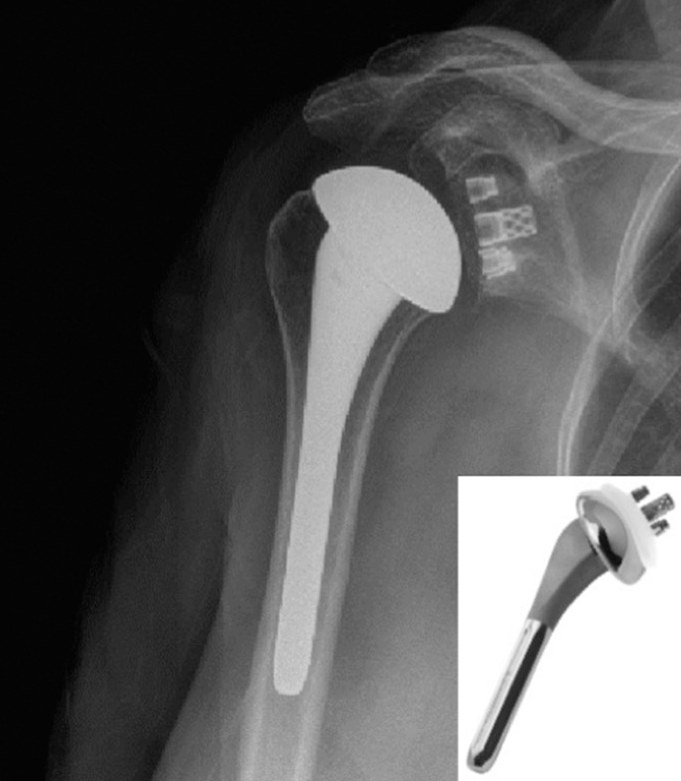
An X-ray of a shoulder after an anatomic replacement. A smooth metal ball sits at the top of the arm bone on a stem running down inside it, and small markers show the new socket fitted to the shoulder blade. An inset photograph shows the implant itself.

An anatomic replacement, on an X-ray

From a peer-reviewed publication on which Dr. Routman is a listed author.

The ball sits where your own ball was, on a stem that runs down inside the arm bone, and the socket is resurfaced on the shoulder blade. The inset is the implant itself, before it goes in.Labrum JT 4th, Routman HD, Friedman RJ, Roche CP, Byram IR. Stemless, short and standard humeral stems in total shoulder arthroplasty: is there a difference in intraoperative measures, pain, and outcomes in the short term? Seminars in Arthroplasty 2023;33:200–6.

In a reverse replacement the ball and socket are swapped — the ball goes on the shoulder blade and the socket on the arm bone. That change lets the deltoid, the big muscle over the outside of the shoulder, do the lifting instead. It is the operation for a shoulder whose rotator cuff is gone or cannot be fixed. There is a separate page on the reverse replacement.

How the choice gets made

It turns largely on your rotator cuff, and after that on the shape and wear of the socket — which is why a CT scan is sometimes ordered before surgery, to plan against the bone you actually have rather than the average shoulder.

Deciding between the two is most of the work of the consultation. It is worth asking your surgeon which one they are planning and why.

Afterward

You will be in a sling, and there is a course of physical therapy. The discharge instructions given after a shoulder replacement are on this site so you can read them again at home, or print them.

Dr. Routman explains shoulder replacement — the difference between an anatomic and a reverse replacement, what to expect afterward, and what tends to go wrong. About 5 minutes.
Read the transcript of this video

Hello, this is Dr. Routman. I'm about to go over with you what it is you need to know if you're considering Shoulder replacement surgery. The overview of this presentation is what is a shoulder replacement and why do people have their shoulders replaced? How do I do a shoulder replacement surgery? What should you expect? If you're having a shoulder replacement surgery. What are the ways that you can mess up a shoulder replacement? And what are the risks of surgery?

To start with, what is shoulder replacement? A shoulder replacement is an operation that replaces the ball and socket of the shoulder joint with low friction metal and plastic material. After the operation, the movement of the shoulder is dependent on your own muscle strength.

There are different types of shoulder replacements, both anatomic and reverse shoulder replacements can be done. An anatomic or standard shoulder replacement replaces the ball with the ball and the socket with a socket. This is really only for patients that have arthritis with a good looking rotator cuff. A reverse shoulder replacement inverts the joint, replacing the ball with a socket and the socket with a ball. This can be used in situations where your rotator cuff is not so good. And it can also be used in salvage situations where there are other things wrong with the shoulder that would make a standard shoulder replacement a bad idea. This is what the replacements look like. On the left, you can see an anatomic shoulder replacement where the ball has been replaced by a ball. But if you look on the right, you can see that the ball is attached to the shoulder blade, inverting the joint.

How do I perform the surgery? Well it's done through an incision in the front of the shoulder. After we go through the skin, the rotator cuff is usually taken off the bone surgically and repaired at the end of the operation in most cases. This becomes important later. I usually use very little to no cement doing shoulder replacement surgery. We give you antibiotics that last around 24 hours and there will be a scar after the operation, but most patients are pretty happy with the appearance of the scar.

The anesthesiologist before the surgery will interview you and determine whether you are a candidate for a nerve block in addition to general anesthetic. We like nerve blocks. They are very effective and they help patients with pain control after the operation. Most patients go home the next day after surgery very comfortable, but there are some patients that can have this operation done as an outpatient or same-day procedure where you go home the same day of the surgery. If this is interesting to you, let me know and we can talk about it.

You will have a sling and an ice device applied to your shoulder on the day of surgery and you'll be able to take them home. There are fancier versions of both the sling and the icing device that are available. It's not usually covered by insurance, but if you're interested, let one of us know and we can talk about it. You'll be provided with prescriptions for your pain medication for after surgery Usually on the day in the office when you're talking about consent with me. Please don't take your post-operative pain medication before the operation or you won't have medication for after surgery. You will have a prescription for physical therapy, occupational therapy, and nursing that will arrange for you to have these people come to your house during the first week after the operation.

Your stitches will be removed at around a week after the operation. After this, you can shower and get the incision wet. Before this, you'll have to use a sponge bath. Sleeping immediately after the operation is easier if you have a recliner. Laying down in bed, it's harder to maintain the same position throughout the night and using a recliner just makes it a little bit easier. Physical therapy can be required depending on the type of replacement that you get done. Reverse shoulder replacements don't usually need physical therapy.

How can you mess this up? Well early on you can cause problems with the shoulder replacement by doing too much or too little. By placing the arms in positions of danger. If you have a standard shoulder replacement at the end of the operation, a rotator cuff repair is performed. And if you use the arm too much after the rotator cuff repair, you can pull apart the repair that I do in the operating room. Later on, after you've had a healed shoulder replacement, trying to see how much the arm can take. Ends up being a problem for some patients. In my experience, people who want to see how much their shoulder replacement can take. Always find out.

What are the risks of surgery? Well, with any surgery, there's risks of infection or nerve or blood vessel damage, but those are really rare. With shoulder replacement surgery, instability, and rotator cuff tearing and loosening of the implants are also possible, but fortunately these are very uncommon. What you should expect is that if you have a shoulder replacement, you will do very well and that your ability to return to the things that you want to do will be reliably restored. Thank you for your attention.

Full transcript of “Shoulder replacement — what patients need to know” (4:44). These are Dr. Routman’s words as recorded. The video is general education and does not predict how any one shoulder will do. Where it differs from the written after-surgery instructions on this site, follow the written ones — those are kept current.

Common questions

What is the difference between an anatomic and a reverse shoulder replacement?

In an anatomic replacement the parts sit the way your own shoulder is built — a ball on the arm bone and a socket on the shoulder blade — and it depends on a working rotator cuff. In a reverse replacement the ball and socket are swapped, so the deltoid muscle does the lifting instead. A reverse replacement is the operation for a shoulder whose rotator cuff is gone or cannot be repaired.

How do I know if I need a shoulder replacement?

It comes down to how much the shoulder is limiting you, what the X-rays show, and whether the things short of surgery have stopped helping. It is a decision made together rather than one read off a scan.

Is a shoulder replacement like a hip or knee replacement?

The principle is the same, but the shoulder is not a weight-bearing joint and depends far more on the muscles around it. The operation and the recovery are different, and so is what counts as a good result.

What if I have already had a shoulder replacement and it still hurts?

That can be looked into and often treated. Revision work — replacements that stay painful or feel loose, and late infections — is a large part of Dr. Routman's practice, and much of it is referred by other surgeons.

Thinking about a replacement

It is worth talking through in person.

(561) 627-8500