
Howard D. Routman, DO

Conditions

Shoulders that still hurt after surgery

A replacement that never felt right. A repair that did not hold. Stiffness that has not improved. An infection that showed up months later. This is a large part of what this practice does.

Revision shoulder surgery

Revision shoulder surgery is the term for operating again on a shoulder that has already had a repair or a replacement. The question is not only whether another operation can be done. It is why the first one did not do what it was meant to.

When an operation has not been successful

Most shoulder surgery works. When it does not, there is usually a reason, and the reason is findable more often than people are told.

  • A replacement that stays painful, feels loose, or clunks
  • A rotator cuff repair that did not heal
  • Stiffness that has not moved despite therapy
  • An infection that developed quietly and only declared itself months afterward
  • A shoulder nobody has been able to explain

The work-up comes before anything else

Second operations are harder than first ones, and they are worth working up carefully before anyone opens the shoulder again. That usually means:

  • New imaging — X-rays, and often a CT scan to see what the bone is actually doing around the implant
  • Blood work
  • Sometimes taking a sample of fluid or tissue from the joint, because a low-grade infection can be quiet enough to look like ordinary pain

Operating without knowing why the first one did not work is how a second one fails too.

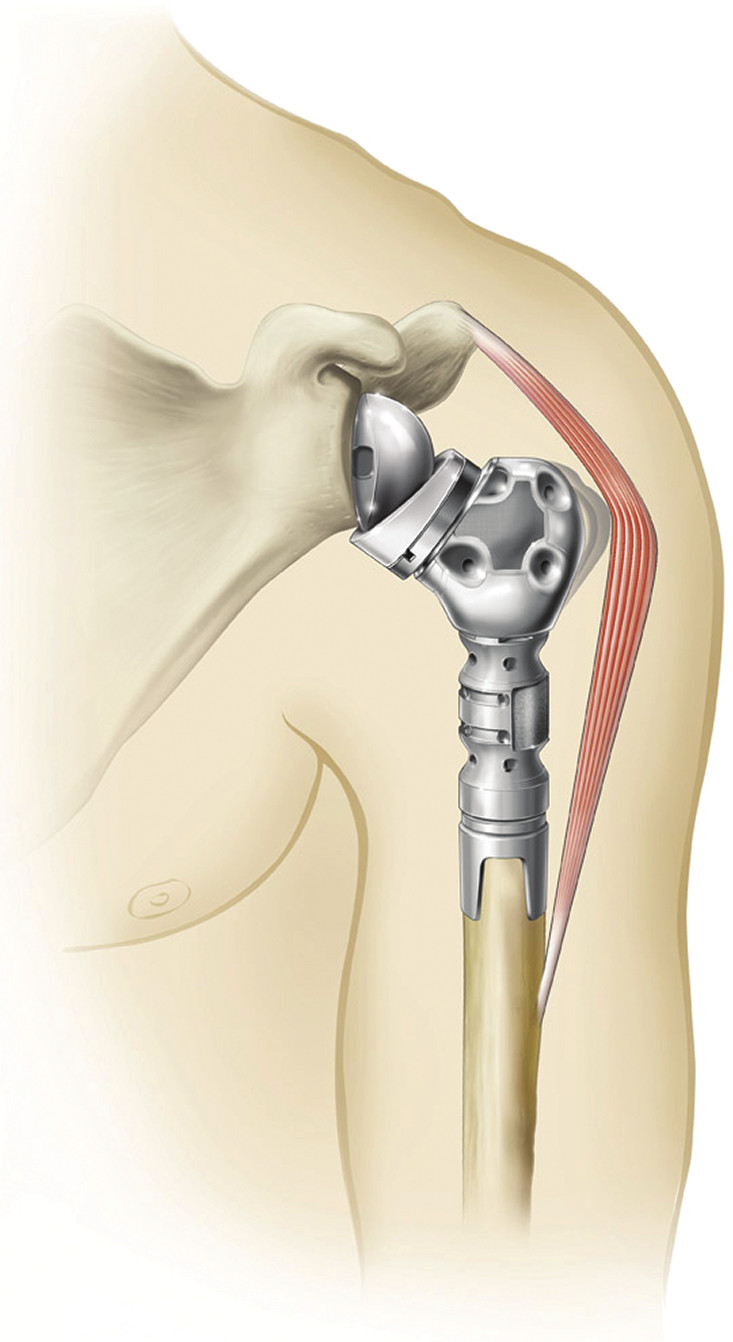
A humeral reconstruction prosthesis in place. A metal ball is fixed to the shoulder blade, and a segmented metal stem replaces the missing upper part of the arm bone, carrying the cup that articulates with the ball.

A humeral reconstruction prosthesis

From a peer-reviewed publication on which Dr. Routman is a listed author.

This is a humeral reconstruction prosthesis, used in complex revision surgery. When earlier operations, a break, or an infection have taken away the top of the arm bone, what is left may not hold an ordinary implant. The reconstruction stem replaces the missing length so the shoulder can be rebuilt around it.Routman HD, Flurin P-H, Wright TW, Zuckerman JD, Hamilton MA, Roche CP. Reverse shoulder arthroplasty prosthesis design classification system. Bulletin of the Hospital for Joint Diseases 2015;73(Suppl 1):S5–14.

Being told nothing more can be done is not always the end of it. It is reasonable to ask someone else to look.Howard D. Routman, DO

Why this practice sees so much of it

A large share of the shoulders Dr. Routman operates on have been operated on before, and much of that arrives as referrals from other surgeons across the region. Revision work is a specific skill: it needs a surgeon who does enough of it to recognize the patterns, and access to the range of implants that a rebuilt shoulder sometimes calls for.

What comes next

If you are thinking about being seen, the practical page is getting a second opinion — in particular the part about bringing the actual images rather than only the reports.

Common questions

Can a shoulder replacement that still hurts be fixed?

Often, yes. A replacement that stays painful or feels loose, a repair that did not hold, stiffness, or a late infection can all be investigated and treated. Revision work is a large part of Dr. Routman's practice and much of it is referred by other surgeons. Being told nothing more can be done is not always the end of it.

How do you find out why a shoulder operation did not work?

With new imaging, usually X-rays and often a CT scan, with blood work, and sometimes by taking a sample from the joint to rule out a low-grade infection. Operating again without knowing why the first operation failed is how a second one fails too.

Is revision shoulder surgery riskier than the first operation?

Second operations are harder than first ones, which is why the work-up beforehand matters so much. What can be expected depends heavily on what is found, and is a conversation to have in person.

Can an infection show up months after shoulder surgery?

Yes. Some infections around a shoulder implant are low-grade and quiet, and can present as pain or loosening rather than as an obviously infected wound. That is one of the reasons a painful replacement is worth testing for infection rather than assuming.

An operation that has not been successful

That is worth another look.

(561) 627-8500