Howard D. Routman, DO

Conditions

Reverse shoulder replacement

The operation that swaps the ball and the socket, so that the deltoid can lift the arm when the rotator cuff no longer can.

What "reverse" means

A normal shoulder has a ball at the top of the arm bone and a shallow socket on the shoulder blade. A reverse replacement turns that around. The ball is fixed to the shoulder blade and the socket to the arm bone.

Why swapping them helps

An ordinary shoulder replacement still needs the rotator cuff to work — the cuff is what holds the ball in the socket and starts the arm moving. If the cuff is gone, an anatomic replacement has nothing to work with, and the shoulder stays weak however good the parts are.

Swapping the ball and socket moves the point the shoulder turns around. That gives the deltoid — the large muscle over the outside of the shoulder — the leverage to lift the arm on its own, without the cuff. It is a mechanical answer to a problem that could not be solved biologically.

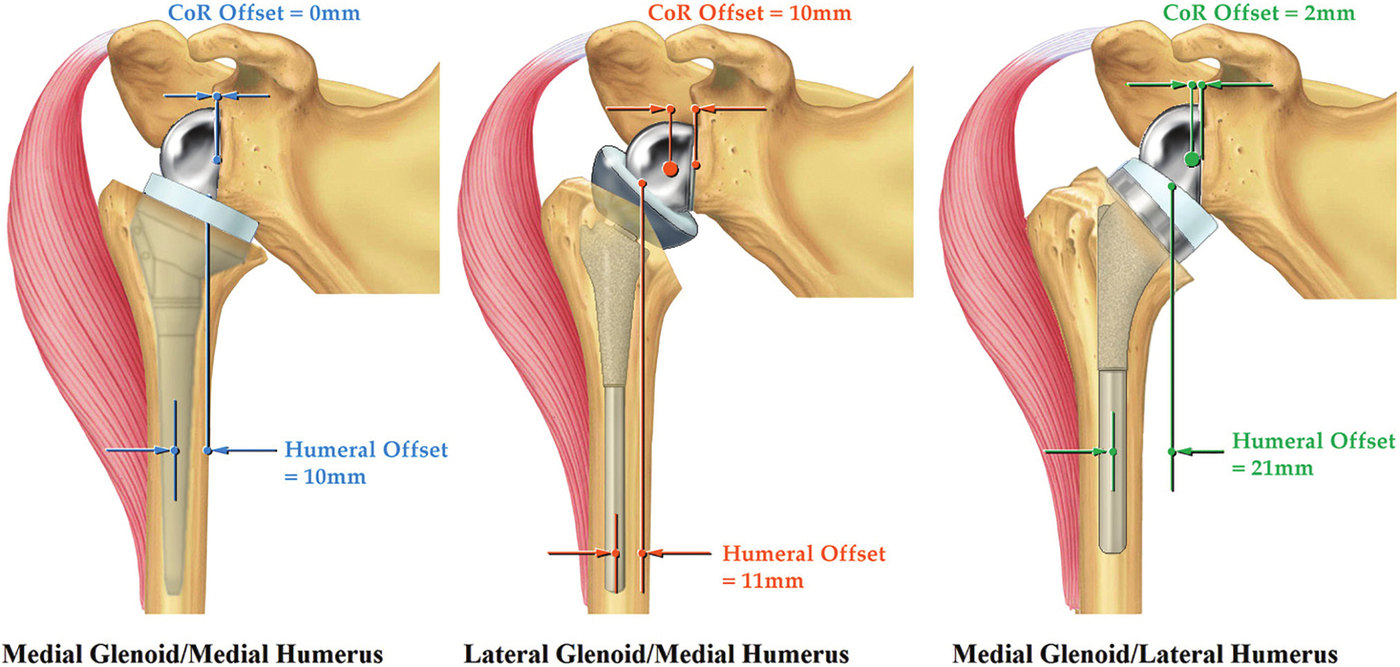
Three reverse shoulder replacements side by side. In each, a metal ball is fixed to the shoulder blade and a cup sits on the top of the arm bone, but the parts are positioned differently, so the joint sits at a different distance from the shoulder blade and from the arm bone.

Three different reverse replacements

From a peer-reviewed publication on which Dr. Routman is a listed author.

Reverse replacements are not all built the same way. These three put the ball and the socket in measurably different positions, which changes how the shoulder moves and how hard the deltoid has to work. Dr. Routman is the first author of the classification system surgeons use to describe those differences, and this is the figure from that paper — the arrows are the measurements that separate one design from another.Routman HD, Flurin P-H, Wright TW, Zuckerman JD, Hamilton MA, Roche CP. Reverse shoulder arthroplasty prosthesis design classification system. Bulletin of the Hospital for Joint Diseases 2015;73(Suppl 1):S5–14.

Who it is for

  • Arthritis in a shoulder whose rotator cuff is also torn beyond repair
  • A large rotator cuff tear that cannot be fixed, in a shoulder that can no longer be raised
  • Some breaks of the top of the arm bone, particularly ones in several pieces, and particularly in older patients
  • A previous shoulder replacement that has failed

It is not the right operation for every worn-out shoulder. If the rotator cuff still works, an anatomic replacement is usually the better answer.

Involved before the operation was approved in the United States

In 2002 Dr. Routman joined an investigational device exemption study run by Encore — the FDA-sanctioned route by which a device can be implanted in the United States before it is approved for general use. In July 2003 he performed the first reverse shoulder replacement done in South Florida. The operation has since changed shoulder surgery worldwide, and it is the reason people whose rotator cuff is beyond repair can now be helped at all.

Afterward

The instructions given after a shoulder replacement, reverse or anatomic, are on this site.

Dr. Routman explains shoulder replacement — the difference between an anatomic and a reverse replacement, what to expect afterward, and what tends to go wrong. About 5 minutes.

Common questions

What is a reverse shoulder replacement?

A shoulder replacement in which the ball and the socket are swapped. The ball is fixed to the shoulder blade and the socket to the arm bone, so the deltoid muscle lifts the arm instead of the rotator cuff.

Why would a surgeon choose a reverse replacement over a normal one?

Because an anatomic replacement depends on a working rotator cuff. When the cuff is gone or cannot be repaired, a reverse replacement is what lets the shoulder be lifted again.

Is a reverse shoulder replacement used for broken shoulders?

Sometimes. Certain breaks at the top of the arm bone, particularly ones in several pieces and particularly in older patients, do better with a reverse replacement than with an attempt to fix the pieces.

Can a failed shoulder replacement be converted to a reverse?

Often, yes. A replacement that has failed can sometimes be revised to a reverse replacement, though a second operation is a bigger undertaking than a first one and needs a careful work-up beforehand.

Thinking about a replacement

It is worth talking through in person.

(561) 627-8500