A short introduction from Dr. Routman. About a minute.Read the transcript of this video
Probably the most common thing that people come to me for are rotator cuff conditions. It can be something where that the rotator cuff which is a small group of muscles around the shoulder are inflamed and causing minimal functional impact and can be managed very easily with medications, physical therapy or whatnot.
Or sometimes folks come in after a fall where they've torn their rotator cuff and now they can't lift their arm. They're on an airplane, they take down a piece of luggage overhead that they think weighs 10 pounds and it ends up weighing 40 and then they can't lift their arm up after that injury. That's something that we typically fix with an arthroscopic rotator cuff repair. So rotator cuff problems are probably the most common thing that I see.
Transcript of the video above, as recorded. Figures Dr. Routman cites were current at the time of filming.
What the rotator cuff is
The rotator cuff is a group of four muscles that surround the shoulder, in its deepest layer — one in the front, one on top, and two in the back. Their tendons attach onto the top of the arm bone. They hold the ball of the shoulder in its socket, and they lift and turn the arm. When one of those tendons pulls away from the bone, that is a tear.
The tendon on top is the supraspinatus, and it is the most commonly torn. When it tears off, it affects the balance of the muscles as they surround the shoulder, and usually results in inflammation and pain.
A tear can be partial, where some of the tendon is still attached, or full-thickness, where that part of the tendon has come away completely. The label matters less than the detail: how big it is, which tendon, and how healthy the muscle behind it still looks.
How it usually happens
There are two patterns, and which one you have is the first question asked in the office.
One is gradual — the tendon frays over years and eventually gives way, often without a moment you can point to. The other is sudden. The shoulder was normal on Monday, there was a specific injury on Tuesday, and by Wednesday the shoulder is a problem and has never been right since. A fall, a hard pull on the arm, or lifting something much heavier than the shoulder was expecting. Reaching up for a bag in an overhead bin is a story we hear often.
The difference matters more than it sounds. A shoulder with no acute injury behind it has the highest likelihood of being treated successfully without an operation. A shoulder with an acute, identifiable injury is far more likely to end up in an operating room.
What it usually feels like
Pain on the outside of the shoulder, sometimes running down the arm
Trouble reaching overhead, behind your back, or into a back seat
Waking at night, especially lying on that side
Weakness lifting, or an arm that feels like it gives out
Pain and weakness when the arm reaches away from the body
Night pain is the symptom that most often brings people in. Getting rid of it provides a huge measure of relief and a real improvement in day-to-day life.
How it is sorted out
An examination and an X-ray come first. An X-ray does not show the tendon itself — it shows the bone, and whether the space the cuff runs through has narrowed. An MRI shows the cuff, and tells us whether the tear is partial or complete, how large it is, and how much healthy muscle is left behind it.
Those details are what the decision actually turns on, which is why the word "tear" on a report is a starting point rather than an answer.
What therapy can and cannot do
Some tears that hurt now will stop hurting. With time and therapy a symptomatic tear can become asymptomatic — silent — and for plenty of people physical therapy, changing what they ask the arm to do, anti-inflammatory medication or an injection is the right place to start.
What changes is the symptoms, not the tendon. A full-thickness tear does not grow back to the bone on its own. The only way a torn tendon heals back to bone is with an operation. The idea that you can go to therapy or have a shot and have a full-thickness tear heal is not accurate. A tear that has gone silent is still a tear.
So the question is not really whether you need an operation. It is what you want the shoulder to do. If the aim is to restore strength and function without restriction, a repair is what makes the most sense. If you are willing to modify your life around a torn tendon inside your shoulder, non-surgical treatment may make sense instead — that depends on your own demands.
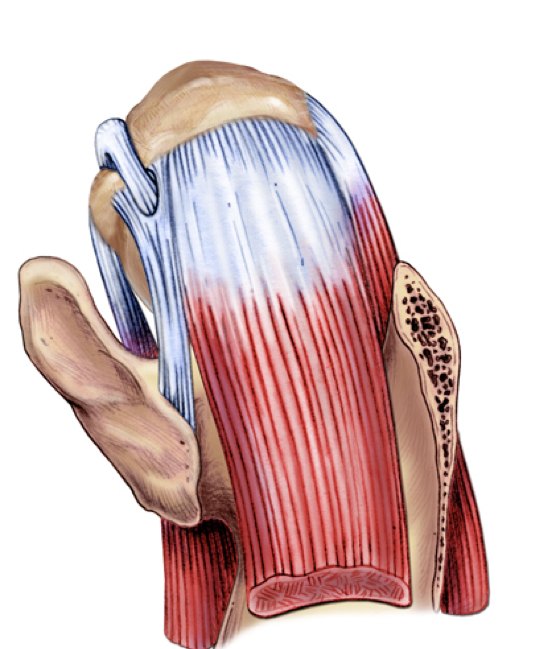
An intact cuff
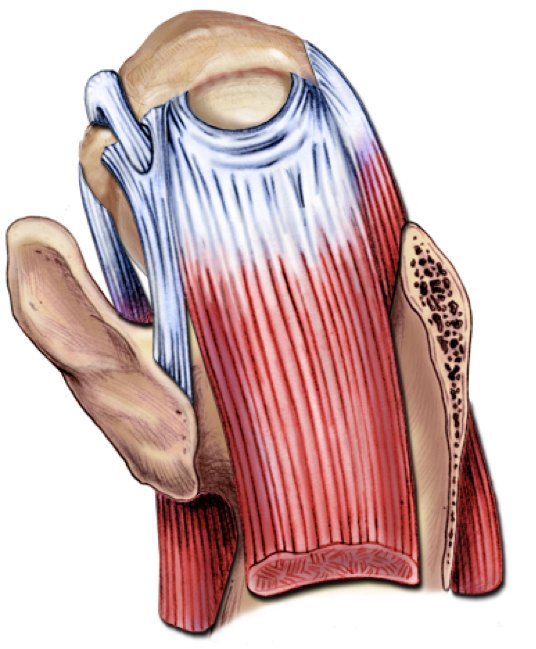
A tear
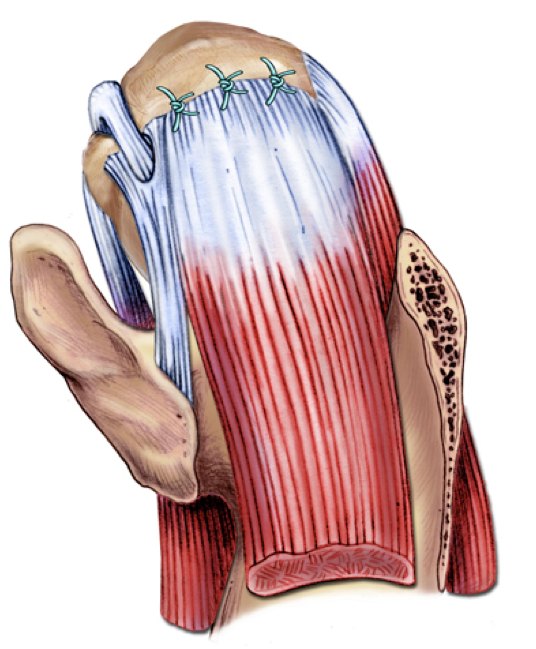
A repair
An intact cuff, a tear, and a repair. The tendon does not close the gap on its own — a repair brings it back to the bone it came off and holds it there while it heals.Illustration by Carol Capers for Howard Routman.
An eighty-two-year-old who wants to dress herself without pain and a high school athlete who wants to play next season have completely different definitions of a good outcome.Howard D. Routman, DO
When an operation is not the answer
A structural problem inside the shoulder, combined with the symptoms it is causing, is what makes someone a candidate for surgery. Being a candidate is not the same as needing an operation.
And even when the tear and the symptoms are both significant, if your medical condition is such that anesthesia would be too dangerous, surgery is not a consideration at all. Dr. Routman is not a cardiologist or a pulmonologist. If you have those specialists on your care team, their view on whether you are safe for anesthesia carries more weight than anything on the MRI. Nothing here is worth doing if it could make you worse.
What a repair involves
Most repairs are done arthroscopically — through several small incisions, with a camera inside the joint. The torn tendon is brought back to the patch of bone it came off and held there with anchors while it heals.
This is the single most common operation that I do. I’ve done over 2,000 arthroscopic shoulder reconstructions.Howard D. Routman, DO
What makes a repair fail
Three things. The soft tissue may not be adequate to support the sutures. The bone may not be strong enough to hold the anchors. Or the biologic environment at the interface between the tendon and the bone may not be supportive for healing.
Three situations put a patient at what Dr. Routman calls a biologic disadvantage: smoking, diabetes, and a repair being done a second time. Two of those three are worth talking about before an operation rather than after it.
When that kind of situation is present there are augmented repairs, where biologic support is added to the repair to improve healing.
Recovery
A sling for six weeks, and physical therapy for a good while after that. The honest window is six months to a year. The tendon has to heal back onto bone, and that biology sets the pace, not how the shoulder feels.
That window is not a formality. When success rates are quoted for this operation, they are quoted at six months and at a year — not at six weeks, and not at three months. Set your horizon properly and this can be a very rewarding and effective operation. If your expectation is a quick fix, rotator cuff repair is not that operation.
Set that expectation properly and most people do well: more than 90% of patients rate this operation as good or excellent.
The discharge instructions given after arthroscopic shoulder surgery are on this site so you can read them again at home.
Dr. Routman explains rotator cuff tears and repair — what the surgery involves, what recovery looks like, and the things that most often set it back. About 6 minutes.
This video includes one photograph taken during surgery.
Read the transcript of this video
Hello, this is Dr. Routman and I'm about to go over with you what it is you need to know if you're considering rotator cuff surgery. The overview of this presentation is What is a rotator cuff tear and why do people have it repaired? How do I do the operation? What should you expect? What are the ways that you can mess this up? And what are the risks of the operation?
What is a rotator cuff tear? The rotator cuff are a group of muscles that surround the shoulder joint. They work together to pull the arm in space and provide stability to the joint, and tears can impair function and cause pain. As you can see in this picture, the muscle starts over on the right, turns itself into a tendon and attaches onto the bone, all the way on the left, right near the arrows. What happens when the tendon tears off the bone is Is that the muscle doesn't know that the tendon has torn, so it keeps on pulling and the tendon retracts further away from the bone. Over time, the tears can become larger. They can get so big they can become impossible to repair. Over time they tend to become softer, thinner, and harder and almost impossible to sew together. During that time the shoulder must adapt to this new reality of having a tear And this can be difficult and some people are really unable to adapt to having a rotator cuff tear effectively.
How do I fix it? Well there's a number of different ways. The traditional repair involves making an incision on the shoulder. It's a medium to large size incision in which we go through the skin and cut through the muscle and get down inside the shoulder to repair the tendon back to the bone. The way that I fix this is with what's called an arthroscopic rotator cuff repair. What we do is we make some poke holes, as you can see on the picture. Each poke hole is around a centimeter in size and allows us to use a digital camera and some high-tech tools to go inside and grab the tendon and sew it back down to the bone. Once it's been sewed down to the bone, the surgery is over, and that is the rotator cuff repair.
In order to actually repair the tendon to the bone, We use suture anchors. Suture anchors are devices that screw in or pop into the bone. The tendons themselves are sewn using stitches that are attached to these anchors, so these anchors are very important to the repair. Some of these anchors are dissolvable, some of them aren't dissolvable. Some of them are made of metal, most of them aren't.
With experience comes reliability. This is the single most common operation that I do. I've done over 2,000 arthroscopic shoulder reconstructions. So, what you should expect is that things are going to go well for you. Also, to expect is that anesthesia is going to interview you and they'll let you know if you're a good candidate for a shoulder block. We love shoulder blocks. Shoulder blocks can be very helpful at managing pain post-operatively, along with the medications that we give you to help make this more comfortable.
On the day of surgery, you will go home, so this is an outpatient procedure, and you will have a sling and an icing device on your shoulder when you leave the surgery center. There are fancier versions of both the sling and the icing device that are available. They're usually not covered by insurance, but if you're interested in them, Just let one of us know and we'll let you know about it. On the day of surgery and probably before that, you'll be given discharge instructions that are in writing. That let you know what to do when you get home. You can usually shower in a few days, but it's not a bad idea to go home now and buy some waterproof Band-Aids, some rubbing alcohol and some regular Band-Aids, because these are effective and helpful for allowing you to shower a few days after surgery. But that will be made very clear in your discharge instructions.
Also, it's very important that you understand that regardless of how good of a job we do repairing the rotator cuff, that you will need to immobilize your shoulder after the operation. The repair requires immobilization in order for the shoulder to heal. You should anticipate that you will need to wear a sling for six weeks. Yes. Six weeks, to be exceedingly clear. If you know that you cannot or will not wear a sling for six weeks, Please do not have your shoulder operated on, as it will be a big waste of your time. Finally, You will require physical therapy done both with a physical therapist and on your own in order to maximize your results. The duration of therapy is highly variable from two months to four months, depending on the patient. And sleeping in a recliner for the first few weeks after surgery really does make things easier for you.
What can you do to mess this up? Well, the number one thing is not wearing your sling or using your arm too soon after the operation. Keep in mind that pain. Is not your guide in terms of when it's safe to use the arm. If we ask you to wear a sling for six weeks, you need to protect the arm for the full six weeks. Once you get to the point where you're doing physical therapy, if you do too much or you do too little, they can both have a negative impact. And finally, Smoking cigarettes has a really negative impact on your ability of the tendon to heal to the bone. If you smoke during the post-operative period, the likelihood of your tendon healing to your bone is much, much lower.
What are the risks of surgery? Well, any surgery has the risk of infection, nerve or blood vessel problems, or anesthesia-related problems. These are all very uncommon. In fact, 93% of patients would rate this operation as good or excellent. So be confident that you'll do well. Specific to rotator cuff surgery, stiffness can be a problem. However, a little bit of stiffness at the beginning of your recovery is actually a good thing. And I would encourage you not to be too worried about getting stiff early on. Your physical therapist and you and me will work together to make sure that you don't get too stiff.
Thanks for paying attention and if you have any other questions just let us know. Thank you.
Full transcript of “Rotator cuff repair — what patients need to know” (6:09). These are Dr. Routman’s words as recorded. The video is general education and does not predict how any one shoulder will do. Where it differs from the written after-surgery instructions on this site, follow the written ones — those are kept current.
Common questions
What are the signs of a rotator cuff tear?
Pain on the outside of the shoulder that sometimes runs down the arm, trouble reaching overhead or behind your back, waking at night when you lie on that side, and pain and weakness when the arm reaches away from the body.
Can a rotator cuff tear heal without surgery?
A full-thickness tear does not grow back to the bone on its own. The symptoms are a separate question — a tear that hurts now can become silent with time and therapy — but the only way a torn tendon heals back to bone is with an operation.
Does every rotator cuff tear need surgery?
No. Some tears that are painful now become silent with time and therapy, and never come to an operation. Others do. Whether a repair makes sense depends on the tear, on what you need the shoulder to do, and on whether you are willing to work around a torn tendon.
What is the difference between a partial and a full-thickness rotator cuff tear?
A partial tear means some of the tendon is still attached to the bone. A full-thickness tear means that part of the tendon has come away completely. Both can be painful, and the size of a tear does not always match how much it hurts.
How long does recovery take after rotator cuff repair?
Expect a sling for six weeks and physical therapy after that, with a recovery window of six months to a year. Success after this operation is measured at six months and at a year, not at six weeks.
What makes a rotator cuff repair fail?
The soft tissue may not be adequate to support the sutures, the bone may not be strong enough to hold the anchors, or the environment where the tendon meets the bone may not support healing. Smoking, diabetes and a second repair all put a patient at a biologic disadvantage.
Is rotator cuff repair done arthroscopically?
Usually, yes. Most repairs are done through several small incisions with a camera inside the joint rather than through one open incision.