About
Howard D. Routman, DO
Board-certified orthopedic surgeon · Fellowship-trained in shoulder reconstruction
Atlantis Orthopedics, a division of South Florida Orthopedics and Sports Medicine
A surgeon who narrowed his practice to one joint, and a teacher responsible for training the next group of orthopedic surgeons.
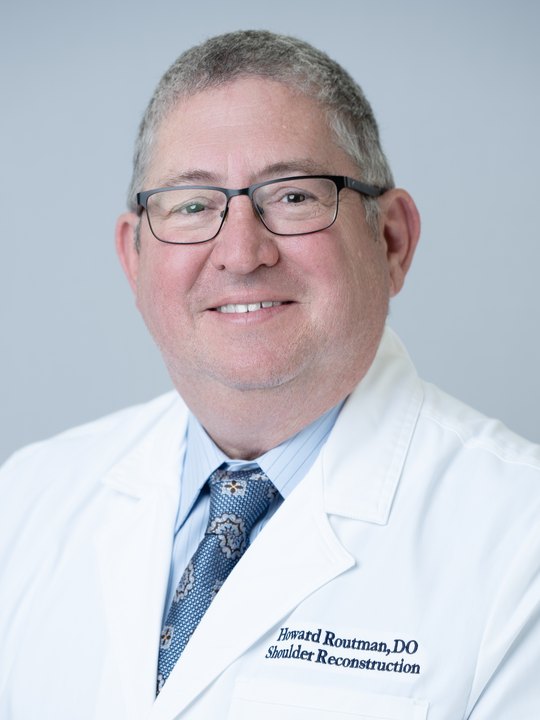
Howard D. Routman, DO is a board-certified, fellowship-trained orthopedic surgeon who has practiced since 2001 and has limited his surgical practice to the shoulder. He treats rotator cuff tears, shoulder arthritis, breaks and dislocations, and shoulders that have already been operated on somewhere else — including anatomic and reverse shoulder replacement, and revision surgery after a repair or a replacement has failed. He directs an orthopedic surgery residency, has published 70 peer-reviewed papers, and helps design the shoulder implants he uses.
Read the transcript of this video
I'm Howard Routman. I'm an orthopedic surgeon. My specialty is shoulder reconstruction. I've been with Atlantis Orthopedics for 23 years. And my practice is really just shoulders. I take care of every type of shoulder problem that there is from instability to fractures to rotator cuff problems and also arthritis. A lot of the stuff that I do is revision shoulder surgery. I think that around a third of the people that come to see me have already had surgery done someplace else and they're coming for an opinion as to what can be done to improve things. I see patients in Lake Worth and Palm Beach Gardens every week and I operate both at the hospital and at surgery center depending on the severity or complexity of the surgery and the health of the individual having an operation.
I grew up in a household where my mother was a art teacher and my father started off selling shoes and went to law school at night after he finished selling shoes during the day and my father was the first person in his family to go to college. When as as the firstborn kid, I went to public school in the state of Florida and got into the University of Florida and when I went to UF, I had a a pretty good time. And then learned pretty quickly that I was drawn more towards the sciences. Had a hands-on class doing some anatomic stuff and it sort of really lit me up. I knew that that was something I wanted to get involved in. I ended up going to back into South Florida to Nova Southeastern to go to medical school and immediately knew that surgery was the direction in which I wanted to go. After a few different experiences in other areas of surgery, I knew it was orthopedics or bust. It was really the only thing that really excited me to wake up in the morning to do and I'm glad I did it.
I did my orthopedic training in Philadelphia and that's where both of my daughters were born. And when I was doing my orthopedic training, the one area that I felt I wanted to learn more about was shoulder reconstruction because there just wasn't a lot of it going on. It was a relatively young field. I mean, hip and knee reconstruction been going on for a while. People were doing spine surgeries and hand surgeries, but there really just wasn't a lot out there in shoulders at the time. Just put this into perspective. Arthroscopic shoulder surgery was being born at the time that I was training. Okay. The idea of putting a camera inside the shoulder to do something was still considered a little bit crazy. They thought the people doing that were sort of cowboys. And so I grew up orthopedically during a time that was pretty cool to be learning shoulder stuff. So my classic training was in doing open shoulder surgery, opening up the shoulder to fix things. But during my career, I've been able to make my way all the way to the minimally invasive tiny little portal keyhole incision surgery where we can do big reconstructions through tiny little incisions.
In addition to that, my research when I was a fellow doing my shoulder fellowship was on this really strange combination of arthritis of the shoulder with rotator cuff problems, which was at the time considered to be a very small percentage of the population. Now we realize it's a much bigger part of the population and reverse shoulder replacement ended up being something that I happen to be launching my career just in time for that to be a major operation that has changed shoulder surgery all over the world.
One of the things that ended up happening was because I was doing complex shoulder surgery in 2002 2003 I ended up getting involved in the investigation of reverse shoulder replacements in the US prior to their FDA approval. So the first reverse shoulder replacement that was done in South Florida, I did as part of an FDA investigation in 2002. So it's been a really interesting journey because shoulder surgery as it is now is very different than it was when I was training and it's been a really exciting time to be doing shoulder surgery. It's a very fulfilling job. So I love what I do.
When patients come to see a shoulder specialist about problems that they're having, they come for many different reasons. Some people are coming just because they're having a hard time sleeping. Other times, people can't even dress themselves without significant pain. Understanding what the individual goals of the patients are and the impact that the problem that they're having is having on them is really the first step because in the end our goal is just to get to the point where someone comes back and says I'm good. And if you can get the patient to the point where they say they're happy, it doesn't really matter to me how we get there. It's a matter of education, activity modification, physical therapy, injections, or surgery. As long as we get to the end to the finish line, which is different for each individual, then we're satisfying the people that we're taking care of. So, my approach is very customized based on the needs and the desires of the individuals that I'm looking after.
You know, I take care of, you know, high school kids that just look at their shoulder playing football and they want to get back to play the next season. And I take care of 82-year-old grandmas, great grandmas who are having a hard time dressing themselves because they can't get the arm away from their body. Totally different sets of expectations, totally different sets of what they would identify individually as being this is a success. So I guess the critical thing is understanding on the front end what does the patient identify as a successful outcome and then working with them with a customized plan of care to be able to achieve that. And that's why it takes some time to sort of get to know your patient and to sort of figure out what it is like what's what's driving them to come to see you in the first place.
Probably the most common thing that people come to me for rotator cuff conditions. It can be something where that the rotator cuff which is this small group of muscles around the shoulder are inflamed and causing minimal functional impact and can be managed very easily with medications, physical therapy or whatnot. Or sometimes folks come in after a fall where they've torn their rotator cuff and now they can't lift their arm. They're on an airplane, they take down a piece of luggage overhead that they think weighs 10 lbs and it ends up weighing 40 and then they can't lift their arm up after that injury. That's something that we typically fix with an arthroscopic rotator cuff repair. So, rotator cuff problems are probably the most common thing that I see.
Also, a really big part of my practice is managing shoulder degenerative conditions. Arthritis of the shoulder, particularly arthritis of the shoulder when it's coupled with degeneration of the rest of the shoulder. So, it used to be thought that arthritis of the shoulder typically happened with the rotator cuff being intact and spared. But we're seeing more and more now that patients have a combination diagnosis where it's not just a rotator cuff issue and it's not just arthritis. It's a combination of the two together and that can be treated really reliably with surgical treatment. So the two most common things that I see are rotator cuff tears and arthritis of the shoulder. In addition to that, there's a sprinkling of trauma broken bones in the shoulder, broken collar bones and things like that. And then shoulder instability. People that have a shoulder that dislocates and keeps on dislocating and require some type of treatment in order to get their shoulder to stop dislocating so they can live their life. That's the that if I was going to say that's the the the edges of my of my practice that that's the the main stuff that I take care of.
I've been involved in the design of a shoulder replacement implant and the implant that I've helped design has been approved by the FDA in the US but it's also been approved by the European Union and a number of other international bodies. So I end up doing a quite a bit of international travel and teaching. So I'm going to Italy on Friday and two weeks later I'm speaking in Dubai and I've done shoulder surgery in Brazil, Australia, all throughout Europe. So I have a lot of frequent flyer miles and I get to go and talk about something that I'm clearly passionate about. I enjoy having conversations with people who are interested in learning the stuff that we've studied. We published a number of papers on this and it's great to be asked to be a part of the educators that are teaching other surgeons the things that we've learned.
And now that I'm just past the halfway point in a career. I'm 23 years into this. It's cool now that I'm I'm the person that's speaking down from the from the podium instead of sitting in there in these meetings and looking up the podium and trying to learn. Despite that, I learn more from each one of these meetings than I go to than I teach because I get to be around some really smart folks. And, we share ideas, share concepts, and I get to come home smarter than I left each time.
When I'm not doing that, I am a pretty avid and not great golfer. I enjoy playing and always trying to work on my game and get better and and I'm trying to figure out how to catch fish and I I haven't quite figured out how to do that properly. I know how to look for them. I just don't know how to catch them very well yet. That's a that's a goal for the next 10 years I hope.
Everyone has a story and everyone really has a very specific thing that is important to them. And I think that you it's important to come prepared to as best as you can clearly articulate what you want out of the care that we're going to try to provide. I think it's always helpful if you can to have someone come with you with when you come in to see a surgeon because we give so much information in in a short visit that numerous studies have shown that if a patient retains 30% of what you talk to them about, they're really listening and paying attention. Sometimes folks will come into the office and with their phones are like, "Can I record this conversation?" And I think that's great because that allows them to go back and listen to the conversation and really relive it and understand that. I think that it's always good to be able to remember as much as you can because if you're coming to get someone's opinion, you want to be able to remember it.
I typically will reach out to my patients when we're talking about surgical intervention and provide them my email address. So if they need to be in contact with me, if they leave and they have questions, they're able to reach out to me directly. And we have a decent amount of information available online for our patients to look at it specifically related to the surgeries that I do and the most common questions that patients might have and the instructions for post-op care so that there isn't any, you know, any daylight between what I think should be done and what the patients think I think should be done. So we have a very good way hopefully of communicating with each individual in that regard.
Transcript of the video above, as recorded. The study Dr. Routman joined in 2002 was an investigational device exemption study run by Encore, sanctioned by the FDA rather than conducted by it; the first reverse shoulder replacement in South Florida was performed in July 2003. Other figures he cites were current at the time of filming.
Practice
Dr. Routman has practiced in Palm Beach County since 2001 and has limited his surgical practice to the shoulder. He directs the Palm Beach Shoulder Service at Atlantis Orthopedics, a division of South Florida Orthopedics and Sports Medicine, and sees patients in Palm Beach Gardens and Lake Worth.
Much of his work involves shoulders that have already been operated on — replacements that never felt right, repairs that did not hold, and infections. Those cases are referred to him by other surgeons across the region.
Training
- ASES Fellowship in Shoulder Reconstruction, The Hughston Clinic and Sports Medicine Foundation, Columbus, Georgia
- Residency in orthopedic surgery, Philadelphia College of Orthopaedic Medicine
- Doctor of Osteopathic Medicine, with highest honors, Nova Southeastern University College of Osteopathic Medicine
- Bachelor of Arts in Sociology, The University of Florida
- Board certified by the American Osteopathic Board of Orthopedic Surgery
Read the transcript of this video
Working with residents on a regular basis, it really allows you to give back because it I wouldn't be able to do what I do if somebody hadn't taken the time to teach me how to do this. The my one of my mentors that is the reason that I'm an orthopedic surgeon just retired recently and I got to go up and see him in Philadelphia and be a part of the group of people that were celebrating his career.
And it does give you perspective to recognize that we do stand on the shoulders of giants. The reason that we were able to do what we do as surgeons in 2024 2025 is because of things that happened and for me 26 28 years ago when someone decided that they were going to choose me out of a pool of a number of applicants to say I'm going to train this person and teach him how to be an orthopedic surgeon.
So, it's a it's nice when you can go full circle on those types of things because the residents that we're training now are the future leaders of tomorrow. And to have the ability to have a hand in that, it's a really big honor. And it's also big shoes to fill because I look at the people that did it for me and I want to make sure that when I'm doing this that I'm making them proud.
Transcript of the video above, as recorded. Figures Dr. Routman cites were current at the time of filming.
Hospital and teaching roles
- Division Chair, Orthopedic Surgery — HCA Florida JFK Hospital and JFK North Campus
- Program Director, Orthopedic Surgery Residency Program — University of Miami / HCA JFK Hospital GME Consortium
- Medical Director, The Orthopedic Institute at HCA Florida JFK Hospital
- Clinical Associate Professor, Orthopedic Surgery — Kiran Patel College of Allopathic Medicine, Nova Southeastern University
- Clinical Associate Professor, Department of Orthopedic Surgery — Florida International University Herbert Wertheim College of Medicine
Research and device design
Dr. Routman studies how shoulder replacements perform over time, and helps design the implants themselves. He has published 70 peer-reviewed papers, nearly all of them on the shoulder, serves as a reviewer for six shoulder and elbow journals, and was inducted into the Neer Circle of the American Shoulder and Elbow Surgeons in 2025.
He works with orthopedic device companies as a design surgeon and consultant, and is paid for that work. Patients are entitled to know that. Every one of those relationships is listed on his curriculum vitae, along with his publications and research studies.
Read the transcript of this video
I'm an associate professor of orthopedic surgery at Nova Southeastern University's MD medical school. Doing research and looking at the things that we can improve for our patient care is very important to me. I've been an author on nearly 50 publications on shoulder reconstruction and most of them have been having to do with reverse shoulder replacement.
I'm a part of a research group that has been collecting data on our patients for over 10 years now and we have some patients that are still following up 15 years after their shoulder replacement. I have nearly 2,000 of my own patients in the registry and our registry has now nearly 20,000 patients in it. So if you can imagine registry of 20,000 patients who have had shoulder replacement, that's some pretty powerful stuff.
So, we've been able to do some amazing things working with artificial intelligence and machine learning to create predictive modeling to be able to predict the outcomes of shoulder replacement surgery before you even touch the patient, which in this day and age is pretty amazing because we know that sometimes the computers can see things that we don't see. Then there might be some features that a patient may have that makes them unique, that makes them a bad candidate or a really good candidate. So finding a way to leverage this information in a positive way to impact patients is something that I'm working on right now.
So I've recently taken on the role of as program director of the orthopedic surgery residency at JFK hospital which is an HCA University of Miami program. We're approved for 15 residents. We are currently three years in, so we have nine. And this is an amazing group of young people that are in training to become orthopedic surgeons.
So I run the program. I'm in charge of making sure that we have adequate academic rigor to make sure that the residents are trained appropriately. When they're working with me directly, they're mostly working on shoulder surgery. But we have other faculty, many of whom are part of Atlantis Orthopedics that are teaching them in different areas of orthopedic surgery. So, hip replacement, knee replacement, pediatrics, foot and ankle. We have all the different areas covered.
So, the residents work with us and if you come see us in the office, you may see a resident floating around with us because they're learning how we do what we do so they can become good orthopedic surgeons down the road.
Transcript of the video above, as recorded. Dr. Routman has since published 70 peer-reviewed papers; the other figures were current at the time of filming.