Howard D. Routman, DO

Conditions

Breaks and dislocations

A shoulder broken in a fall, or one that keeps slipping out of joint. Some are fixed, some are replaced, and some do best left alone and watched closely.

Breaks at the top of the arm bone

A fall onto an outstretched hand, or onto the shoulder itself, can break the upper end of the arm bone. This is one of the more common fractures in older adults, and it is also one where doing less is often the right answer.

Many of these breaks heal in a sling, without an operation. What decides it is how far the pieces have moved apart, how many pieces there are, the quality of the bone, and what you need the arm to do. Breaks in several pieces, or ones where the blood supply to the ball is at risk, are the ones that more often need fixing — or, in an older patient, a reverse replacement, which can be the more reliable answer than trying to rebuild a badly broken ball.

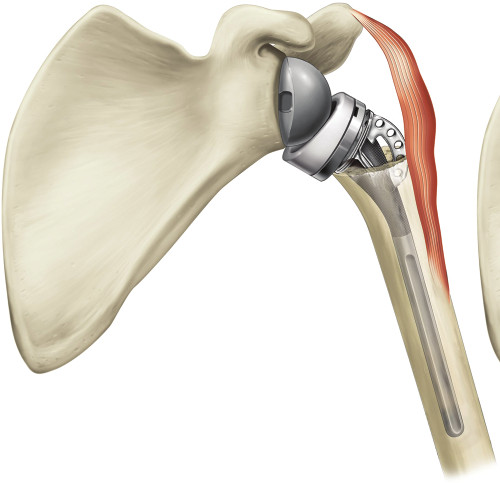
A reverse shoulder replacement used to treat a broken shoulder. A metal ball is fixed to the socket of the shoulder blade and a cup on a stem sits in the top of the arm bone.

A reverse replacement done for a break

From a peer-reviewed publication on which Dr. Routman is a listed author.

When the ball is broken into several pieces, rebuilding it may not hold. Replacing it — with the ball and socket swapped, so the shoulder does not depend on the broken pieces healing back in the right place — is sometimes the more reliable answer.Routman HD. Indications, technique, and pitfalls of reverse total shoulder arthroplasty for proximal humerus fractures. Bulletin of the Hospital for Joint Diseases 2013;71(Suppl 2):S64–7.

Early movement matters in either case. A shoulder that is protected too long gets stiff, and stiffness is its own problem to solve afterward.

Shoulders that come out of joint

The shoulder trades stability for range of movement — it is the most mobile joint in the body and the one that dislocates most easily. A shoulder that has come out once often comes out again, particularly in younger and more active people.

Each dislocation can damage the rim of the socket and the ring of tissue around it, and enough of that damage makes the next one easier. So the question after a dislocation is usually not only how to put it back, but whether it needs stabilising so it stops happening.

Some shoulders are unstable without ever fully dislocating — they slip, catch, or feel like they are about to give way. That is worth having examined too.

How it is sorted out

X-rays first. A CT scan shows the shape of the broken pieces or the bone loss around the socket, and an MRI shows the soft tissue. Which of those is needed depends on what the examination and the first X-ray suggest.

Common questions

Does a broken shoulder always need surgery?

No. Many breaks at the top of the arm bone heal in a sling without an operation. Whether surgery is needed depends on how far the pieces have moved, how many there are, the quality of the bone, and what you need the arm to do.

Why would a broken shoulder be replaced rather than fixed?

When the ball is broken into several pieces, or its blood supply is at risk, trying to rebuild it may not hold. In some patients, particularly older ones, a reverse shoulder replacement is the more reliable answer.

If my shoulder has dislocated once, will it happen again?

It often does, particularly in younger and more active people. Each dislocation can damage the rim of the socket, which makes the next one easier, so a first dislocation is worth being assessed rather than simply put back.

What is shoulder instability?

A shoulder that slips, catches, or feels like it is about to give way, whether or not it fully comes out of joint. It is worth examining, because the underlying damage is the same kind that leads to repeated dislocations.

Just broken or dislocated a shoulder

Call and we will get you seen.

(561) 627-8500